Supporting Your Transgender Loved Ones: A Therapist’s Guide for Family & Friends

Someone You Love Just Told You They are Transgender — Now What?
First and foremost, take a moment to recognize something important: they chose to tell you. In a world where being transgender is still stigmatized and often misunderstood, opening up about one’s identity takes incredible courage. It means they trust you. They value your presence in their life, and they want you to see them for who they truly are. That’s something special.
You might have a lot of questions—about what this means, how to respond, or even how it might affect your relationship. All these questions are valid, and they reflect how much influence your loved one has in your life. Equally important to consider: “This must’ve been tough for them—how can I best support them?”
The first step is educating yourself—even if this space feels unfamiliar. Remember, any discomfort you feel is a fraction of what they’ve likely experienced. It’s also not their job to teach you everything about being transgender; they’ve already done a lot of emotional work just by opening up to you. Instead, take the initiative to read, listen, and learn from reliable sources.
Generational awareness around gender has grown significantly. If you were raised with a binary view of gender, this is an opportunity to expand your understanding of gender as a continuum. Approaching this learning with curiosity, compassion, and openness helps us grow, both interpersonally and in how we experience the world.
What Does the Term Transgender Mean?
Science has yet to determine exactly what predicts how a person will identify in terms of sexual orientation or gender identity. What we do know is that no single variable—biology, environment, or life experience—determines identity; most likely, all of these factors play a role. That diversity contributes to the rich tapestry that makes up humankind (The Trevor Project, 2019).
Transgender describes someone whose gender identity doesn’t match the sex they were assigned at birth (typically based on anatomy). It’s not a choice, a phase, or about appearance—those are harmful, misleading myths. Being transgender is as real and intrinsic as eye color; it’s simply part of who someone is. While not true for everyone, many transgender people also experience gender dysphoria (psychological distress from the incongruence between gender and biological sex), often intensified by social stigma and a lack of understanding within their families, communities, and other important spaces. This is why a strong support system matters so much: research shows that an average of 42% of LGBTQ youth seriously considered suicide in the past year, with even higher rates among transgender and nonbinary youth—and that having just one supportive person consistently present in their life can cut that risk in half (The Trevor Project, 2021). If you or someone you love is struggling, The Trevor Project (1-866-488-7386, or text START to 678-678) offers 24/7 crisis support, and Trans Lifeline (877-565-8860) provides peer support from fellow trans people.

What’s the Difference Between Biological Sex, Sexual Orientation, Gender Identity, and Gender Expression?
In my work with clients exploring their identities, one of the most common sources of stress comes from feeling like the world confuses terms like sex, gender, and orientation, using them as if they’re interchangeable. Though often lumped together, they’re each distinct parts of who we are. Understanding the difference can deepen empathy, reduce stigma, and support mental well-being—for yourself or someone you love. Let’s break them down:
Biological Sex: This refers to the physical characteristics you’re born with—chromosomes, hormones, reproductive organs, and secondary sex traits. Most infants are labeled male or female at birth, but that’s an oversimplification: intersex individuals are born with anatomy that doesn’t fit neatly into either category.
Gender Identity: This is your internal sense of self—how you feel and understand your own gender. You might identify as a man, a woman, both, neither, or somewhere in between. This identity might match your biological sex—or it may not. When it doesn’t, a person may identify as transgender or nonbinary.
Gender Expression: Gender expression is how you outwardly present your gender identity through things like clothing, hairstyle, voice, or behavior. It’s what the world sees, but it may or may not reflect someone’s internal identity. A person assigned male at birth might wear makeup or skirts traditionally labeled as feminine simply because that’s how they feel most authentic—not necessarily because they identify as transgender.
Sexual Orientation: This has nothing to do with gender identity or expression. Sexual orientation refers to who you’re emotionally, romantically, or sexually attracted to. Someone can be cisgender (identify with the sex they were assigned at birth) and gay, transgender and straight, nonbinary and bisexual—the combinations are as diverse as humanity itself.
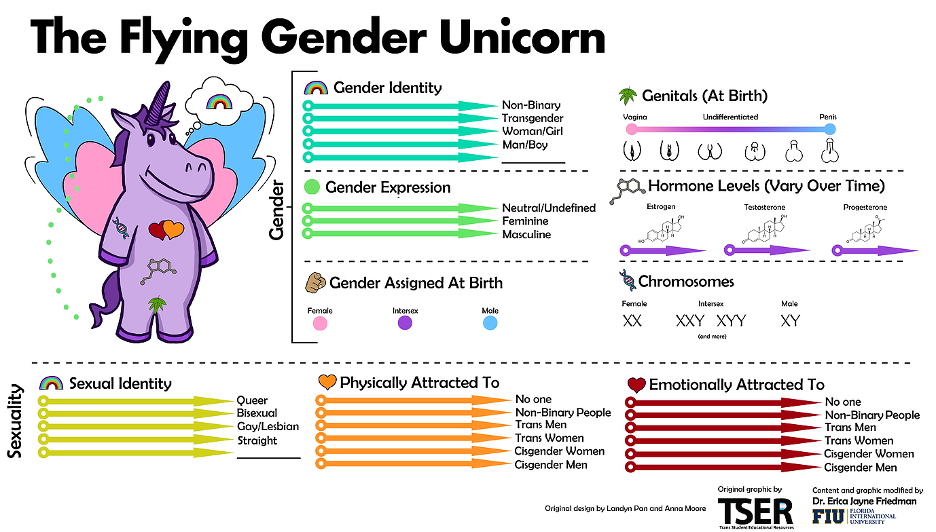
*Image Credit: Florida International University
Developed by Associate Director of LGBTQA Initiatives at FIU, Dr. Erica Jayne Friedman, the Flying Gender Unicorn is a tool used to expand on a discussion of differences between sexuality identity, sexual attraction, emotional attraction, gender identity, gender expression, and gender assigned at birth.
How Can You Best Support Your Loved Ones?
To understand the best way to support a community, it helps to first understand their risk factors. Research has consistently shown that transgender people who are rejected by family, friends, or their community are far more likely to engage in self-harm or consider suicide because of the distress they experience—sometimes as early as age four. Approximately 54.8% of transgender individuals report self-injury, and 31% have attempted suicide; however, those with supportive people in their lives are 82% less likely to attempt suicide. If you take one thing away from this, let it be the impact you have on someone simply by showing up for them. (Taliaferro, 2019)
One of the best ways to show up for a loved one is to be authentically present in their life. Be there when they need to talk, and ask questions with the goal of understanding their experience. Many people are afraid of saying the wrong thing or simply not understanding, so they shy away from what feels like a difficult conversation. But showing genuine interest and a desire to understand—through asking questions—shows that you care, that you want to get it right, and that you’re prepared to walk this road with them.

Why it Matters
Understanding these distinctions helps create safer, more supportive environments for everyone. For some, clarifying these terms can be a lifeline—it validates their experience and reduces feelings of shame and confusion. For others, it’s a chance to expand their empathy and build deeper connections. If you’re feeling unsure or overwhelmed, that’s okay. What matters most is your willingness to listen, learn, and approach each person as the expert on their own experience.
References
American Psychiatric Association. (2013). Diagnostic and statistical manual of mental disorders (5th ed.). Arlington, VA.
Becerra-Culqui, T., Liu, Y., Nash, R., Cromwell, L., Flanders, D., Getahun, D., & Goodman, M. (2018). Mental health of transgender and gender nonconforming youth compared with their peers. American Academy of Pediatrics. 141,5. DOI: 10.1542/peds.2017-3845.
Birnkrant, J. M. & Przeworski. (2017). Communication, advocacy, and acceptance amongsupport-seeking parents of transgender youth. Journal of Gay and Lesbian Mental Health. 21:2 , 132-153. DOI: 10.1080/19359705.2016.1277173
The flying gender unicorn. (2020, July 15). Retrieved from: https://studentaffairs.fiu.edu/get-involved/social-justice-and-inclusion/pride-center/_assets/theflyinggenderunicorn.pdf
Panagiotakopoulos, L. (2018). Transgender medicine - Puberty suppression. Reviews in Endocrine and Metabolic Disorders. 19 , 221-225. doi:10.1007/s11154-018-9457-0.
Priest, M. (2019). Transgender children and the right to transition: Medical ethics when parents mean well but cause harm. American Journal of Bioethics. 19 (2) :45-59.
Ruth, R. R. & Santacruz, E. (2017). LGBT psychology and mental health: Emerging research and advances. Santa Barbara, CA.
Trevor support center glossary. (2019, May 21). Retrieved from https://www.thetrevorproject.org/trvr_support_center/glossary/
The Trevor Project. (2021). 2021 National Survey on LGBTQ Youth Mental Health. West Hollywood, California: The Trevor Project.
Turban, J. L. & Keuroghlian, K.S. (2018). Dynamic gender presentations: understanding transition and “de-transition” among transgender youth. American Academy of Child and Adolescent Psychiatry, 57:7 , 451-453. DOI:10.1016/j.jaac.2018.03.016.
Understanding gender. (2019, May 22). Retrieved fromhttps://www.genderspectrum.org/quick-links/understanding-gender/.