When Food Becomes Safety: How Trauma Drives Binge Eating Disorder

Binge eating disorder (BED) is the most common eating disorder in the United States (NIMH, n.d.), and one of the most misunderstood. It affects people of every gender, age, body size, culture, and income level, and it carries real social, psychological, and medical consequences. But a growing body of clinical research points to what the willpower narrative misses entirely: for many people, binge eating does not begin with food. It begins with trauma.
Trauma — whether acute, relational, developmental, or chronic — destabilizes the systems we rely on to process emotion, regulate stress, and feel at home in our own bodies. In that state, binge eating becomes less a symptom of impulsivity and more a strategy for survival. Shame sits at the center of it, quietly reinforcing the belief that something is fundamentally wrong with you, rather than with what happened to you.
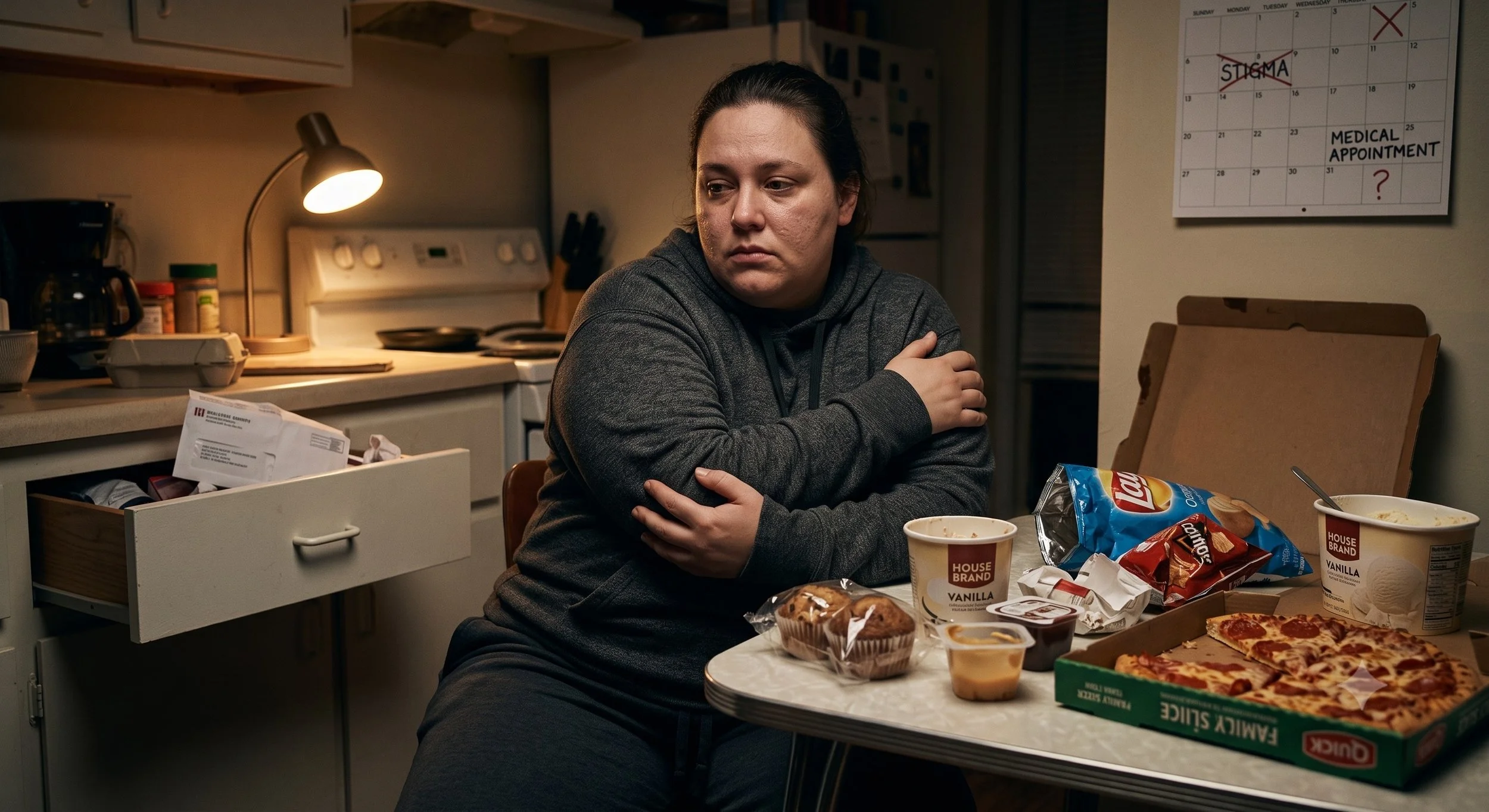
Understanding Binge Eating Disorder
BED involves recurring episodes of eating large quantities of food in a short period, accompanied by a sense of lost control and significant distress. Unlike bulimia nervosa, it does not involve regular compensatory behaviors such as purging or fasting — a distinction that contributes to its underdiagnosis (Quilliot et al., 2019). The DSM-5-TR (2022) describes eating rapidly, eating until uncomfortably full, eating when not physically hungry, eating alone out of embarrassment, and feeling disgust, shame, or guilt afterward.
Despite how common it is, BED is still mistaken for a lifestyle problem or a failure of willpower rather than a serious mental health condition (Groth et al., 2020). Stigma around weight and eating obscures diagnosis and delays referral, particularly for people in larger bodies (Palmisano et al., 2016). Food insecurity, weight-based discrimination in medical settings, cost barriers to care, and cultural messaging that equates thinness with worth all deepen internalized shame — which in turn fuels binge eating and discourages people from asking for help.
BED develops through a mix of biology, psychology, and lived experience. Differences in the brain systems governing impulse control, reward, and hunger create vulnerability, as do difficulties with distress tolerance, emotional regulation, and a stable sense of self (Feinson & Hornik-Laurie, 2016). Body image, weight stigma, and chronic stress add further risk. But binge eating is rarely just about food. For many people it becomes a way to manage overwhelming emotion — a way to feel briefly safe, in control, and numb (Frost et al., 2025). That is especially true for those whose earlier means of self-soothing were disrupted by trauma (Fischer et al., 2014).

How Trauma Changes the Body and Brain
Trauma occurs when an experience overwhelms a person’s capacity to cope, disrupting their sense of safety and altering how they relate to themselves, others, and the world. It is defined not only by what happened, but by its lasting effects on the body, mind, and relationships (Frost et al., 2025). It can follow a single event, ongoing stress, or repeated experiences — and when it occurs in childhood, it can shape emotional regulation and stress response for decades, including vulnerability to eating disorders (Groth et al., 2020; Quilliot et al., 2019).
Trauma also changes how the body responds to stress. The nervous system may stay on high alert, making it hard to feel calm or safe even when no danger is present (Convertino & Mendoza, 2023). The result can be emotional overwhelm, numbness, or impulsivity, because the brain’s self-regulation systems work less effectively under sustained stress.
Emotionally and relationally, trauma can make feelings hard to name or soothe, and can erode self-worth and trust in others. Shame, fear of rejection, and disconnection are common, particularly when the trauma occurred inside close relationships (Serra et al., 2020). In that context, behaviors such as binge eating develop as ways to cope with distress or regain a sense of comfort and control. They are not personal failures.

Why Trauma Leads to Binge Eating
Many people who struggle with binge eating have a history of trauma — particularly experiences of feeling powerless, unsafe, or emotionally unsupported. Research consistently shows that exposure to neglect, abuse, or chronic stress, especially in childhood, raises the likelihood of binge eating later in life (Groth et al., 2020; Quilliot et al., 2019).
When a child’s needs are ignored, punished, or minimized, they may never learn reliable ways to manage uncomfortable feelings. Food can become the dependable source of comfort instead (Groth et al., 2020), and eating — especially in large amounts — can temporarily soothe anxiety, anger, loneliness, or sadness (Echeverri-Alvarado et al., 2020). To the body and brain, a binge registers as relief, even when that relief is brief.
Trauma also leaves behind worthlessness, shame, and self-blame (Palmisano et al., 2016). These feelings tend to sit quietly beneath the surface while exerting enormous influence on behavior. Binge eating offers an escape from them. For some people, binge episodes are also linked to dissociation — a sense of disconnection from the body — which makes it easier to eat past fullness without registering it. Bullying, weight stigma, and shame in medical settings deepen the same cycle: feeling judged leads to hiding, hiding leads to isolation, and isolation makes the next binge more likely.

The Binge–Shame Cycle, and Why It Repeats
Trauma keeps binge eating going by making stress and emotion harder to manage. When sadness, anxiety, anger, or loneliness arrive, the nervous system can be overwhelmed within moments (Convertino & Mendoza, 2023). Bingeing numbs the pain, calms the distress, and restores a sense of control. The relief does not last — but the brain remembers it, which makes the next binge more likely.
Afterward comes guilt, shame, and self-criticism, which lead to secrecy and withdrawal and so increase distress rather than relieving it (Quilliot et al., 2019). As that stress builds, the urge returns, and the cycle closes (Peterson et al., 2000). Trauma tightens the loop by reinforcing beliefs like “I don’t deserve care” or “something must be wrong with me,” which make self-compassion feel unavailable.
Over time the cycle changes a person’s relationship with their own body. Trauma can sever the connection to physical signals like hunger and fullness, making it genuinely difficult to notice when you have had enough (Groth et al., 2020). Seeing how trauma maintains this cycle moves the focus away from blame and toward healing. With trauma-informed care, it is possible to learn new ways to regulate emotion, reconnect with the body, and interrupt the loop.

What Trauma-Informed Treatment Looks Like
Treatment works best when it addresses both the eating behavior and the emotional wounds underneath it. Trauma-informed care begins by establishing safety, choice, and trust in the therapeutic relationship (Peterson et al., 2000). Rather than emphasizing control or restriction, therapy helps you understand bingeing as a coping response and build steadier ways to manage emotion and stress, at a pace that feels safe (Convertino & Mendoza, 2023).
Healing is not about eliminating urges quickly. It is about building tools and self-compassion. When trauma is addressed alongside eating behavior, people begin to feel safer in their bodies, less governed by food, and more connected to their own emotions (Fischer et al., 2014). That is what makes change durable rather than temporary.
Binge eating is not a failure of willpower. For many people it develops as a way to survive overwhelming emotion, unmet needs, and chronic stress rooted in what happened to them. Recognizing that shifts the work away from self-blame and toward something far more useful: understanding, and then change.
Recovery from binge eating disorder involves more than changing how you eat. It means addressing the emotional and relational injuries underneath. With the right support, recovery is not only possible but sustainable — a steadier relationship with food, and a more compassionate one with yourself. If any of this sounds like your experience, it may be worth speaking with a therapist who works at the intersection of trauma and eating. You are not failing at something simple. You are coping with something hard, and there is a way through it.
References
American Psychiatric Association. (2022). Diagnostic and statistical manual of mental disorders (5th ed., text rev.). https://doi.org/10.1176/appi.books.9780890425787
Convertino, A. D., & Mendoza, R. R. (2023). Posttraumatic stress disorder, traumatic events, and longitudinal eating disorder treatment outcomes: A systematic review. International Journal of Eating Disorders, 56(6), 1055-1074.
Echeverri-Alvarado, B., Pickett, S., & Gildner, D. (2020). A model of post-traumatic stress symptoms on binge eating through emotion regulation difficulties and emotional eating. Appetite, 150, 104659.
Feinson, M. C., & Hornik-Laurie, T. (2016). Binge eating & childhood emotional abuse: The mediating role of anger. Appetite, 105, 487-493.
Fischer, S., Meyer, A. H., Dremmel, D., Schlup, B., & Munsch, S. (2014). Short-term cognitive-behavioral therapy for binge eating disorder: long-term efficacy and predictors of long-term treatment success. Behavior Research and Therapy, 58, 36-42.
Frost, G., Strodl, E., & Akosile, W. (2025). Meta-emotion therapy for complex trauma and binge eating: A case study. Psychological Trauma: Theory, Research, Practice, and Policy, 17(4), 904–911. https://doi.org/10.1037/tra0001675
Groth, T., Hilsenroth, M., Boccio, D., & Gold, J. (2020). Relationship between trauma history and eating disorders in adolescents. Journal of child & adolescent trauma, 13(4), 443-453.
Hudson, J. I., Hiripi, E., Pope, H. G., & Kessler, R. C. (2007). The prevalence and correlates of eating disorders in the National Comorbidity Survey Replication. Biological Psychiatry, 61(3), 348–358. https://doi.org/10.1016/j.biopsych.2006.03.040
NIMH. (n.d.). Binge-eating disorder. https://www.nimh.nih.gov
Palmisano, G. L., Innamorati, M., & Vanderlinden, J. (2016). Life adverse experiences in relation with obesity and binge eating disorder: A systematic review. Journal of Behavioral Addictions, 5(1), 11-31.
Peterson, C. B., Crow, S. J., Nugent, S., Mitchell, J. E., Engbloom, S., & Mussell, M. P. (2000). Predictors of treatment outcome for binge eating disorder. International Journal of Eating Disorders, 28(2), 131-138.
Quilliot, D., Brunaud, L., Mathieu, J., Quenot, C., Sirveaux, M. A., Kahn, J. P., ... & Witkowski, P. (2019). Links between traumatic experiences in childhood or early adulthood and lifetime binge eating disorder. Psychiatry research, 276, 134-141.
Serra, R., Kiekens, G., Tarsitani, L., Vrieze, E., Bruffaerts, R., Loriedo, C., ... & Vanderlinden, J. (2020). The effect of trauma and dissociation on the outcome of cognitive behavioral therapy for binge eating disorder: A 6‐month prospective study. European Eating Disorders Review, 28(3), 309-317.